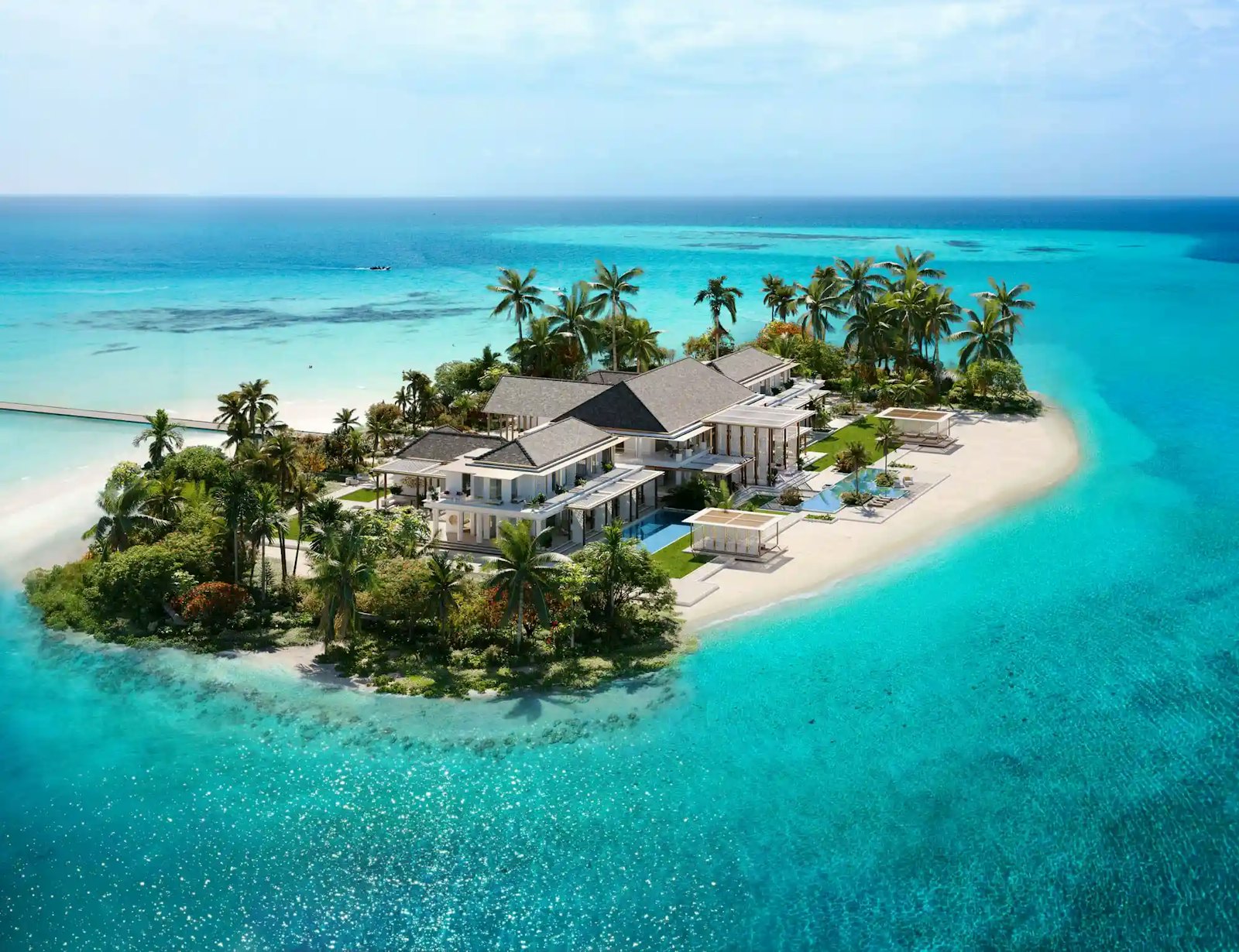
The Maldives in 2026: A Market Measured by Scarcity
The Maldives is one of the most exclusive real estate markets on the planet — defined not by transaction volume but by structural scarcity. Only a few dozen branded residences change hands in any given year, integrated into globally renowned resorts across a protected archipelago. Supply is constrained by geography, environmental controls and strict development rules, and that scarcity is the engine of long-term value.
The demand base is exceptional. According to published tourism data, the Maldives closed 2025 with more than 2.2 million arrivals and tourism receipts above USD 5.4 billion — a record — with the luxury segment accounting for roughly half of hospitality revenue. This is the platform underneath the branded-residence market: record average daily rates and full occupancy at the top end translate into a credible leaseback income thesis for owners.
This report sets out directional pricing, the branded-residence pipeline, the ownership framework, the forces driving 2026 demand and — importantly — the honest risks. All figures are directional, drawn from published market data and developer pricing; GADAIT confirms every number programme by programme before any commitment.
Directional Prices by Typology
There is no single price per square metre in the Maldives; value is set by brand, format, atoll and lease terms. The ranges below are directional, based on developer-published pricing, and give a realistic sense of entry points across the market.
| Typology | Indicative range (USD) | Example programmes |
|---|---|---|
| Leaseback investment unit (1–2 bed) | ~$1M – $4M | Off-plan, resort-managed rental |
| Branded beach / lagoon villa (2–4 bed) | ~$4.5M – $13M | Baccarat, Soneva Jani & Fushi |
| Overwater branded villa | ~$5M – $15M | Resort-linked, top-tier operators |
| Private mansion / island estate | $15M – $45M+ | Baccarat mansions, Zamani estates, Aman |
Directional only, based on published market data and developer pricing. Actual prices, lease terms and availability vary by programme and are confirmed on request.
Branded Residences: The 2026 Pipeline
A handful of globally recognised names define ownership in the Maldives. Each pairs a brand with a specific atoll, format and stage — from the Baccarat Hotel & Residences now selling in South Malé, to the barefoot ultra-luxury of Soneva and the forthcoming Aman Residences. Total supply is measured in dozens of units — a defining feature of the market.
| Residence | Atoll | Format | Indicative from | Status |
|---|---|---|---|---|
| Baccarat Hotel & Residences | South Malé Atoll | ~53 residences + 7-bed mansions | ~$4.75M | Selling |
| Aman Residences | Vaavu Atoll | 16 private-island residences (5–10 bed) | On request | Under construction |
| Soneva Private Residences | Baa & Noonu | Beach & overwater villas | ~$5M | Operational |
| Zamani Islands | South Malé Atoll | Suites, beach & water villas, mansions & estates | Estates from $17.499M · suites & villas on request | Off-plan |
| Amilla | Baa Atoll | Beach & lagoon residences | On request | Operational |
Beyond these addresses, a wave of new luxury operators is entering the archipelago through 2026–2027 — Mandarin Oriental, Bvlgari, Rosewood and Capella among them — several bringing branded residences. As always in the Maldives, announced opening dates move; a slip of 12–24 months between launch and delivery is normal, not exceptional.
The Defining Addresses in Detail
Baccarat Hotel & Residences — South Malé Atoll
The market's headline sales launch: a South Malé programme pairing the Baccarat name with around 53 private residences and a collection of seven-bedroom mansions in Signature, 1764 and Baccarat styles, alongside 50+ hotel villas. Per developer pricing, residences start from approximately $4.75M and rise to $25M+, with a staged payment plan and an opening targeted for around 2027.
Aman Residences — Vaavu Atoll
Perhaps the purest expression of scarcity in the market: just 16 private-island residences, each set on its own islet with a private beach, a 25-metre pool and a personal landing jetty, in a secluded part of Vaavu Atoll. Villas span five to ten bedrooms. Pricing is by private application; construction is underway with delivery expected in the 2026–2027 window.
Soneva Private Residences — Baa & Noonu
The pioneer of barefoot ultra-luxury and the most established ownership track record in the country. Per published figures, only around 31 residences have been sold since 2011 across Soneva Fushi and Soneva Jani — a vivid illustration of how thin supply is. Directional pricing runs from roughly $5M for smaller villas to well above $13M for larger ready residences.
Zamani Islands — South Malé Atoll
The largest development currently underway: eight islands in a single lagoon by Atoll Estates, with three resorts (DVNES, Vibrant, Elegant) and what the developer describes as the Maldives' first superyacht marina. Ownership comes in three forms — DVNES suites, Vibrant one- and two-bedroom beach and water villas, and Elegant mansions and estates published from $17.499M (developer prices, October 2026).
How Ownership Works
Foreigners cannot acquire freehold land in the Maldives. International buyers acquire through long-term leasehold — up to around 99 years — within government-approved developments and branded resort residences, subject to government approval. Most assets run on a resort-managed leaseback model. The full ownership guide is set out in our Maldives buying guide.
| Item | What to expect |
|---|---|
| Foreign ownership | Leasehold / usage rights — no freehold land |
| Maximum lease term | Up to ~99 years, programme-specific |
| Approval | Government approval within an authorised framework |
| Annual property tax | None for individual owners |
| Tourism taxes (TGST, Green Tax) | Apply at the resort-operator level |
| Local mortgages | Uncommon — payment plans, private banking or cash |
Directional only. Taxation of rental income and capital gains depends on your home jurisdiction and holding structure — we confirm the full picture with specialised legal and tax partners before any commitment.
Three Forces Behind the Market
The Maldives market in 2026 is shaped by a rare alignment of scarcity, record demand and new supply from the world's leading hospitality brands.
- Ultra-limited supplyOnly a few dozen branded residences exist in the Maldives, and environmental controls cap how much can ever be built. Scarcity is structural — the defining driver of long-term value.
- Record tourism demandPer published data, 2025 delivered over 2.2 million arrivals and USD 5.4 billion+ in receipts, with the luxury segment holding roughly half of revenue and the highest average daily rates in the region — the foundation of leaseback income.
- A wave of new openingsAman, Mandarin Oriental, Bvlgari, Rosewood, Capella and Baccarat are among the brands entering or expanding through 2026–2027, several with residences — deepening the market while keeping unit counts deliberately small.
The Buyer Profile
Maldives branded residences attract a narrow, global buyer base: ultra-high-net-worth individuals and family offices, typically transacting in USD. Motivations blend a trophy lifestyle asset with a professionally managed leaseback income stream, and increasingly a diversification play across ultra-luxury hospitality real estate. Cash and structured private-banking financing dominate, as local mortgages for non-residents are uncommon.
For this profile, the Maldives sits alongside markets such as Dubai, Mauritius and the French Alps in a broader capital-allocation conversation — one where GADAIT advises across destinations rather than a single market.
Honest Risks & Considerations
A Maldives residence is a managed lifestyle investment, not a standard property purchase. The strongest acquisitions are made with these factors understood from day one.
Why Work with GADAIT in the Maldives?
The Maldives is not a volume market; it is an excellence market where precision matters. We treat each asset as a managed investment, not just a lifestyle purchase — with off-market access and multi-destination advisory.
FAQ — Maldives Real Estate Market 2026
The Maldives is an ultra-niche market measured by scarcity, not volume — only a few dozen branded residences trade in any given year. According to published market data, tourism receipts surpassed USD 5.4 billion in 2025 on more than 2.2 million arrivals, with the luxury segment accounting for roughly half of hospitality revenue. That demand base underpins a branded-residence pipeline of a handful of globally recognised names, with directional pricing ranging from around $1M for leaseback investment units to $25M and above for private-island mansions.
Prices are directional and vary by brand, format and atoll. Based on developer-published pricing, branded beach and lagoon villas typically start from around $4.75M (for example at the Baccarat Hotel & Residences), overwater and larger villas run from roughly $5M to $15M, and private-island mansions and estates reach $25M and above. Leaseback-oriented investment units can start from around $1M according to developer figures. GADAIT provides current price lists on request.
The market remains deliberately small — a handful of active branded-residence programmes rather than a mass market. Landmark projects include the Baccarat Hotel & Residences (South Malé, around 53 private residences plus mansions), Aman Residences (16 private-island residences in Vaavu Atoll), Soneva Private Residences, Zamani Islands and Amilla. Several more resort brands are entering the market through 2027, but total supply is measured in dozens of units, not thousands.
Foreigners cannot acquire freehold land in the Maldives. International buyers acquire through long-term leasehold — up to around 99 years — within government-approved developments and branded resort residences, subject to government approval. Most assets are structured as resort residences with defined usage rights and a leaseback model rather than outright land ownership.
For the right profile, yes — but as a managed lifestyle investment, not a liquid property play. The thesis rests on structural scarcity, record tourism demand, strong brand-led average daily rates and a leaseback income model. The trade-offs are niche resale liquidity, dependency on the resort operator, USD exposure and climate/insurance considerations. Assets tied to top-tier brands and prime atolls are the most resilient.
Three forces: ultra-limited supply (only a few dozen branded units worldwide), record tourism performance (over 2.2 million arrivals and USD 5.4 billion+ in receipts in 2025 per published data), and a wave of new luxury openings — Aman, Mandarin Oriental, Bvlgari, Rosewood, Capella and Baccarat among them through 2026–2027. Buyers are predominantly UHNW individuals and family offices transacting in USD.
The main risks are honest and specific: resale liquidity is thin in a niche market; income and service quality depend on a single resort operator; low-lying islands require robust insurance and construction standards; transactions and income are USD-denominated, adding FX exposure; and owner-use calendars reduce rental nights. We model these factors before any commitment.
Branded resort residences are typically operated under a leaseback or managed rental programme, with the resort handling distribution, service and occupancy. Income depends on brand strength, seasonality and operations; assets tied to top-tier brands benefit from stable global demand and higher average daily rates. Figures are directional and confirmed programme by programme.
Continue Your Research


Newsletter
Be among the privileged.
Subscribe to the Gadait International newsletter and receive the latest trends in the luxury market, along with exclusive opportunities for exceptional properties in advance.
Low frequency. High relevance.