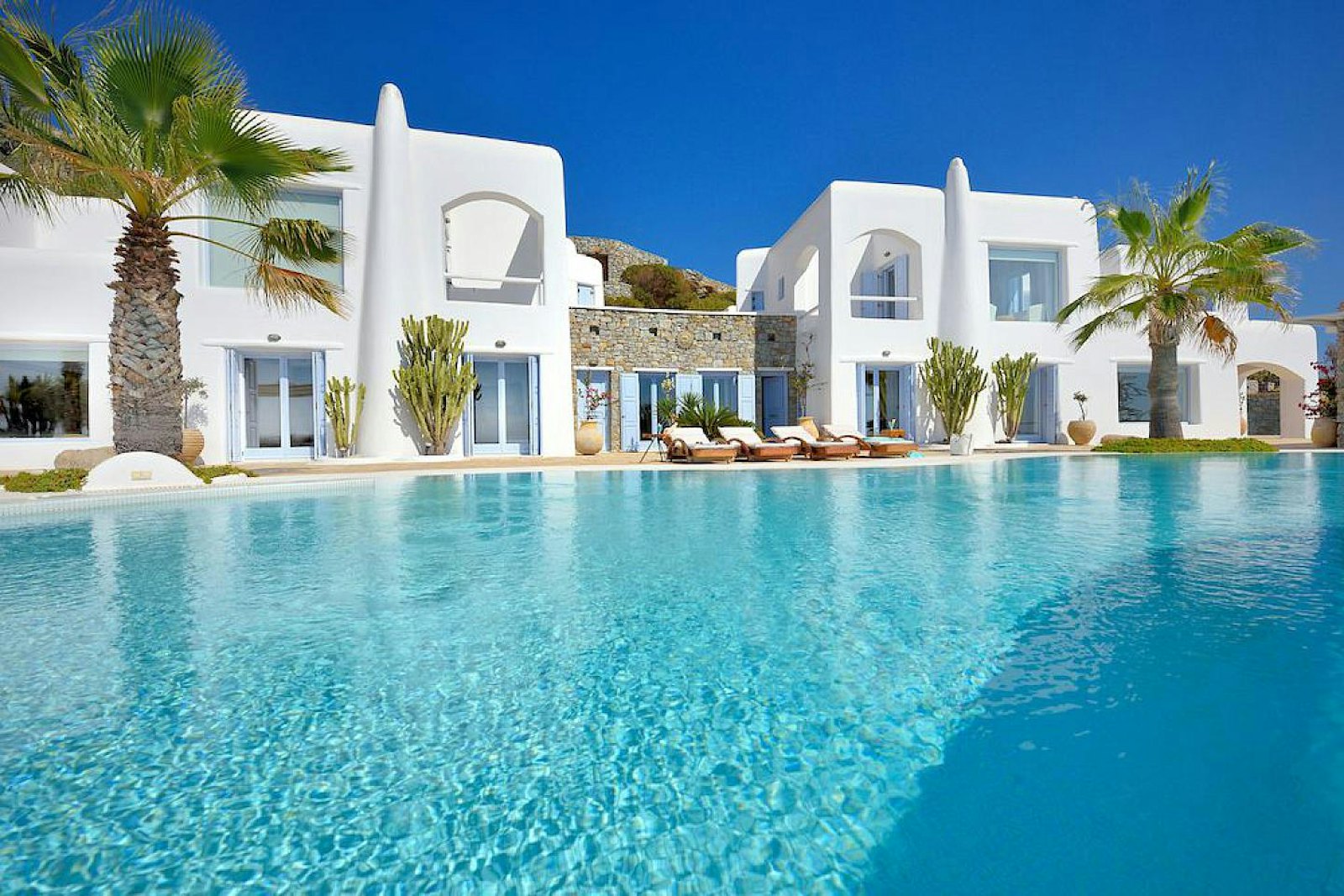
Greek residential prices are still rising but decelerating — apartments +7.8% in 2025 nationally (Bank of Greece), down from +9.1% in 2024, with regional cities outrunning Athens. The Cyclades luxury segment ranges from Naxos value (~€2,000–4,000/m²) to Mykonos and Santorini trophy pricing (€10,000/m²+). Demand is underpinned by Golden Visa flows (Law 5162/2024, €800k / €400k tiers), a new-build VAT suspension to end-2026 and record 2025 tourism. Honest risks: seasonality, island permitting, tightening short-term-rental rules and variable liquidity.
Greece in 2026: Rising Prices, Deep Demand, Selective Value
Greek residential prices extended their run through 2025. Apartment prices rose 7.8% on average over the year according to the Bank of Greece — a clear deceleration from the +9.1% of 2024, but still well ahead of most of the eurozone. Growth broadened beyond the capital: Thessaloniki (+9.6%), other cities (+9.8%) and other areas including the islands (+8.8%) all outran Athens (+6.2%), which is cooling from a high base after years of double-digit gains.
The luxury story sits in the Cyclades, where prime sea-view assets have appreciated faster than the national index and supply is structurally scarce. As an independent buying advisor, GADAIT does not push one island's inventory — we compare the market objectively for each client and manage the Greek Golden Visa pathway where it applies. All figures below are directional orders of magnitude drawn from market data and the Bank of Greece indices, not valuations of a specific asset.
National Residential Prices (Bank of Greece)
The Bank of Greece residential property price index shows apartment prices up 7.8% for 2025 as a whole, with the fourth quarter around +7.6% year-on-year — a soft landing rather than a reversal. The regional and by-age breakdown makes the pattern clear.
| Segment | 2025 price growth | Read-through |
|---|---|---|
| Athens | +6.2% | Deepest mainland market, decelerating from a high base |
| Thessaloniki | +9.6% | Fastest-rising major city in 2025 |
| Other cities | +9.8% | Broadening demand beyond the capital |
| Other areas | +8.8% | Islands & regional markets, incl. the Cyclades |
| New apartments | +7.4% | Supported by the new-build VAT suspension |
| Old apartments | +7.8% | Renovation & prime-location demand |
Source: Bank of Greece, indices of residential (apartment) property prices, full-year 2025 averages. National indices are directional and do not reflect the pricing of a specific asset.
Prime Prices by Cycladic Island
The Cyclades are not one market. Price levels, liquidity and Golden Visa treatment differ sharply island to island. The figures below are directional €/m² orders of magnitude for prime property — trophy caldera and coastal villas can exceed the upper bound.
| Island | Prime price level | Golden Visa | Profile |
|---|---|---|---|
| Mykonos Most liquid | €6,000–12,000+/m² | €800k | Trophy assets, deepest rental & resale market |
| Santorini Scarcity | €4,500–15,000/m² | €800k | Caldera scarcity, iconic-view premium |
| Paros GADAIT's pick | €4,000–8,000/m² | €800k | Balance of upside & authenticity |
| Antiparos €400k tier | €4,000–9,000/m² | €400k | Discreet enclave, lower visa threshold |
| Naxos Value | €2,000–4,000/m² | €800k | Value & space, longer horizon |
Directional only. €/m² ranges are orders of magnitude for prime assets based on 2026 market data; Santorini caldera positions and Mykonos coastal villas sit at the top of the range. Golden Visa tiers per Law 5162/2024 — always confirm the current classification per island and property.
Five Drivers Behind Greek Demand in 2026
The Greek bid is structural, not a single catalyst. Five forces are doing most of the work — and each has a shelf life worth understanding before you commit.
Golden Visa: The €800k / €400k Split
Under Law 5162/2024, Greece's Golden Visa property thresholds are tiered by location. High-demand zones — Attica, Thessaloniki and, by name, Mykonos and Santorini — sit at €800,000, as does any island with more than 3,100 residents (pulling in Paros, Naxos and Syros). Smaller islands below that population, such as Antiparos, remain at €400,000. A €250,000 route survives for commercial-to-residential conversions and listed-building restorations, alongside a €250,000 Elevate Greece startup pathway. Applications spiked to a record before the reform (~9,300 main investors in 2024) and approvals kept climbing into 2026, even as new filings normalised.
| Zone / island | Threshold | Why |
|---|---|---|
| Attica & Thessaloniki | €800,000 | High-demand zones named in the law |
| Mykonos & Santorini | €800,000 | Named prime islands in the law |
| Paros · Naxos · Syros | €800,000 | Population above 3,100 residents |
| Antiparos | €400,000 | Population below 3,100 residents |
| Conversions / restorations | €250,000 | Commercial-to-residential or listed buildings |
Thresholds per Law 5162/2024 and subsequent guidance. Golden Visa qualifying properties are banned from short-term rental. Classification can be updated — we confirm the current tier for the specific island and property. See our Greek Golden Visa guide for the full framework.
Risks We Flag Before You Buy
A rising market is not a riskless one. These are the recurring points we stress-test on every Greek acquisition — the strongest purchases are made with them understood from day one.
Why Read the Greek Market with GADAIT?
We are an independent buying advisor, not a single-island agency. That means we can tell you honestly when a market is fully priced, where the value still sits and which Golden Visa threshold applies — then source the right asset, on- or off-market.
FAQ — Greece Real Estate Market 2026
Nationally, residential prices kept climbing through 2025: apartment prices rose on average 7.8% over the year according to the Bank of Greece, easing from 9.1% in 2024, with the fourth quarter around 7.6% year-on-year. Growth was strongest outside Athens — roughly 9–10% in Thessaloniki and other cities versus about 6% in Athens. In the Cyclades luxury segment, prime sea-view assets have appreciated faster still. Figures are directional national indices, not a valuation of a specific asset.
As directional orders of magnitude for prime property: Mykonos roughly €6,000–12,000+/m² (prime coastal villas above €10,000/m²), Santorini €4,500–15,000/m² (caldera positions €9,000–15,000), Paros €4,000–8,000/m², Antiparos €4,000–9,000/m² and Naxos €2,000–4,000/m². Actual pricing depends heavily on location, view and the individual asset — trophy caldera and coastal villas can exceed the upper bound.
It depends on location. Under Law 5162/2024, high-demand zones — Attica, Thessaloniki and, by name, Mykonos and Santorini — sit at €800,000, as does any island with more than 3,100 residents (which includes Paros, Naxos and Syros). Smaller islands below 3,100 residents, such as Antiparos, remain at €400,000. A €250,000 route survives for commercial-to-residential conversions and restorations of listed buildings, plus a €250,000 startup pathway. Always confirm the current classification before committing.
The directional case is constructive: prices are still rising (if decelerating), international demand is deep, tourism set fresh records in 2025 (~38 million visitors, ~€23.6bn receipts), the new-build VAT suspension runs to end-2026 and island supply is structurally scarce. Against that, yields have compressed after years of gains, seasonality and island permitting add friction, and short-term-rental rules are tightening. We build an asset-by-asset case rather than a market-timing call.
Yes, for now. The suspension of 24% VAT on new-build residential sales has been extended to 31 December 2026 (Law 5246/2025). Qualifying new homes fall outside VAT and instead attract only the much lower transfer tax (around 3–3.09%), materially reducing acquisition costs. The regime is optional for the developer, so confirm the status of each specific project before relying on it.
Yes. Greece places no general restriction on foreign ownership, including for non-EU buyers, and freehold ownership is available. You need a Greek tax number (AFM) and a local bank account; properties in designated border or strategic zones require prior approval. Buying at the relevant threshold can also qualify the owner for the Greek Golden Visa residence permit.
Seasonality — many islands have a short high season and thinner off-season access; island permitting, forestry maps and titles need careful due diligence; short-term-rental rules are tightening, and Golden Visa qualifying properties cannot be let on short-term platforms at all; and liquidity is variable — Mykonos resells fastest to the broadest pool while Santorini, Antiparos and Naxos are thinner, relationship-driven markets that need a longer exit horizon.
Within the islands, Mykonos is the most internationally recognised and liquid market, reselling fastest to the broadest buyer pool, with Paros liquidity deep and improving. Athens offers the deepest mainland market. Santorini, Antiparos and Naxos are thinner and more relationship-driven, so plan a longer selling horizon there.
No. Under the current rules, properties acquired to qualify for the Golden Visa are banned from short-term rental (Airbnb-style) letting. Separately, several areas — including central Athens and, from 2026, tourist zones flagged for expansion such as Santorini and Paros — are freezing new short-term-rental registrations, and Law 5170/2025 adds safety standards and a two-property limit per individual. Confirm the current regime for the exact asset before assuming rental income.
Greek island markets are opaque, seasonal and heavily off-market. As an independent buying advisor, GADAIT compares islands and asset classes objectively rather than pushing one inventory, verifies title, permitting and rental licensing, negotiates on your behalf and manages the Golden Visa pathway where it applies — materially reducing risk on a cross-border purchase.
More questions on buying in Greece
Request the Greece Market Read & Selection
Get our current read on Greek prices, the Cyclades island-by-island view, Golden Visa thresholds and an off-market Greek selection curated for qualified buyers.
Greece & the Golden Visa
Newsletter
Be among the privileged.
Subscribe to the Gadait International newsletter and receive the latest trends in the luxury market, along with exclusive opportunities for exceptional properties in advance.
Low frequency. High relevance.